Editor’s Note: Warren Beatty had a box office hit in 1978 with his comedy Heaven Can Wait, and he was nominated for best director and best actor. Freeline Media critic Milan Paurich revisits Heaven Can Wait, and believes it has a unique status in movie history today. Read on!
By Milan Paurich
There’s something improbably touching about Warren Beatty and Buck Henry’s 1978 romantic fantasy Heaven Can Wait because it arrived at precisely the moment when the style of movie it signifies was supposedly dying. The old studio system had been dismantled, New Hollywood directors had taken over and films were becoming tougher, dirtier, more personal and downright suspicious of the very notion of glamour. The audience for an OG comedy had seemingly vanished along with the type of theaters that formerly housed them. Yet here was Heaven Can Wait with its gorgeous stars, immaculate sets, mistaken identities, celestial bureaucracy, improbable coincidences, football, murder, class satire and unabashedly sentimental love story behaving as though none of that had ever happened.
Yet, somehow it works.
In fact, Heaven Can Wait may be the last great old-fashioned Hollywood romantic comedy; the last movie in which the machinery of classical Tinseltown fantasy, screwball comedy and romantic yearning operates without apology or the self-consciousness that would soon become mandatory. It isn’t necessarily the “last” great romantic comedy. Films continued to be made that were romantic and funny, sometimes wonderfully so. But this particular species — the star-driven big studio confection in which fantasy, farce and romance were allowed to coexist as naturally as champagne and strawberries–definitely seems to have ended here.
The movie itself is a delightful piece of recycling. It’s based on Harry Segall’s play which had previously been filmed as Here Comes Mr. Jordan in 1941 with Robert Montgomery as a boxer who dies prematurely and is given another chance at earthly life. The 1978 iteration changes the hero into Joe Pendleton, a Los Angeles Rams quarterback played by Beatty, but retains the basic comic-fantasy premise.
The title itself is such an Inside joke that you have to admire its audacity. The ’78 film is called Heaven Can Wait even though it was the title of an entirely unrelated 1943 Ernst Lubitsch comedy starring Gene Tierney and Don Ameche. In other words, Beatty’s movie is a remake of Mr. Jordan that steals the title of another film entirely. Apparently Hollywood history isn’t a straight line, but a filing cabinet in which somebody misplaced the labels.
Joe Pendleton is a quarterback preparing for the biggest game of his life when an overzealous celestial escort (played by Buck Henry with precisely the right mix of bureaucratic efficiency and sheepish embarrassment) prematurely removes him from his body. The mistake is soon discovered, but there’s a small problem: Joe’s body has already been cremated. So, rather than simply putting him back where he came from, the heavenly authorities have to find him another body.
That body belongs to Leo Farnsworth, a fabulously wealthy industrialist who has just been murdered by his wife Julia (Dyan Cannon) and personal secretary Tony Abbott (Charles Grodin). Joe, now inhabiting Farnsworth’s body, discovers that being rich isn’t nearly as much fun as being Joe Pendleton — and that there’s an environmental activist named Betty Logan (Julie Christie) with whom he’s fallen hopelessly in love.
In other words, the plot is completely ridiculous. And that’s important because Heaven Can Wait knows just how absurd it is without ever becoming embarrassed by it.
A modern filmmaker approaching this material would almost certainly feel compelled to signal that the movie “understands” its own ridiculousness. There would be quotation marks around the fantasy, perhaps some winking references (e..g, a character who says, “This is crazy!”) That’s one reason the film has aged so gracefully: it doesn’t confuse sophistication with cynicism.
Beatty, making his feature debut as director alongside Henry, understands that the picture needs to float. He doesn’t impose a conspicuous auteurist sensibility on the material. Instead, he gives the movie room to breathe, allowing the actors and the situations to establish the rhythm. The screenplay, credited to Beatty and Elaine May, is similarly unobtrusive in the best sense.
And what a cast!
Beatty is perfectly cast because Joe is essentially Beatty’s most winning screen persona stripped of irony. He’s handsome, athletic, cocky without being obnoxious, fundamentally decent and possessed of the peculiar confidence of a man who never had to wonder if people will find him attractive. Beatty’s great gift here is that he doesn’t make Joe into a narcissist, he makes him lovable.
Julie Christie, meanwhile, brings something much rarer to a Hollywood rom-com: an actual moral intelligence. Betty isn’t just the beautiful woman the hero has to win. She’s politically and socially engaged, deeply suspicious of the corporation Joe’s new body represents and capable of recognizing something decent in the man inside the millionaire’s body. The romance itself has an uncommon sweetness. Joe doesn’t fall for Betty because the plot says he must. He falls for her because she represents the life he suddenly realizes he wants.
Mason’s Mr. Jordan is a marvel of Olympian understatement, the kind of performance in which an actor can appear to be doing almost nothing while communicating an entire philosophy of existence. He’s the perfect celestial authority because Mason never seems to be trying to be funny. He simply allows his magnificent voice and extraordinary dignity to collide with the increasingly preposterous circumstances.
If Mason is celestial serenity, Jack Warden’s Max Corkle is earthbound bewilderment. Max is Joe’s former trainer and confidant, the one person who can sense that something impossible has happened even if nobody else believes him. Warden and Cannon were both Oscar-nominated for their performances (Beatty received a Best Actor nomination).
Heaven Can Wait earned 9 Oscar nominations total, but if we’re talking about the film’s true claim to comic immortality, there’s only one place to go: Charles Grodin.
Grodin’s Tony Abbott is simply one of the single funniest creations in the history of cinema comedy. Not one of the funniest supporting performances, not one of the funniest performances in a fantasy, but one of the funniest performances period.
Grodin’s genius is that Tony isn’t played as a conventional comic foil. He’s simply a man who believes, with almost religious conviction, in his own dignity. Tony has murdered his employer, is conspiring with the man’s wife, has every reason to panic and yet his greatest concern is maintaining an appearance of stoic dignity. This is the Grodin paradox: the more desperate Tony becomes, the more he insists on behaving like a man who has everything under control.
Grodin’s physical stillness is extraordinary. The clipped delivery, little pauses and offended looks. The way his face seems to register every inconvenience as a personal affront to the natural order of the universe. He doesn’t “do” comedy in the conventional sense. He behaves as though the world has become an intolerable inconvenience and he’s determined not to let anyone see how much it bothers him.
And then there’s the scene where Joe comes into Julia’s bedroom, forcing Tony to hide behind a curtain. When Joe–who’s fully aware of his wife and secretary’s affair — addresses the hidden presence, Tony (gulp) answers him.
Once Joe leaves the room, an indignant Julia asks why he responded. Tony’s explanation — “His will was too strong” — is the sort of perfectly stupid, supremely logical line that makes a comedy immortal. It’s Grodin’s reaction that makes the sequence so priceless. He looks like a man whose entire understanding of reality has just been revised against his will.
That’s what makes Grodin’s performance so damn hilarious: Tony Abbott never seems to know that he’s in a comedy. Grodin plays him with the solemnity of a man trapped in a Bergman movie who has somehow wandered into a Marx Brothers picture. It is, in the most sublime way possible, the Grodin-iest of Grodin performances: sniveling, supremely unctuous, self-important, terrified and utterly convinced that everybody else is behaving improperly.
Cannon, too, understands the film’s comic wavelength. Her Julia Farnsworth could easily have become a shrieking caricature, but Cannon gives her enough hauteur to make the hysteria even funnier. She isn’t merely a villainess, she’s a woman who simply can’t believe that the universe has the nerve to inconvenience her.
And this is where Heaven Can Wait most resembles the greatest studio comedies. Everybody is allowed to be larger than life without becoming cartoonish. That’s the old Hollywood magic.
The movie also contains something modern romantic comedies have increasingly lost: romance without shame. Joe’s love for Betty isn’t a punchline. It makes us believe that this man, after being given a second chance at life in another person’s body, has discovered what his original existence was supposed to be about. The fantasy element is ultimately a machine for getting him to that realization.
And the ending earns the sentiment because the film has been building toward it with such unerring patience. Max’s recognition of what’s happened; Joe’s uncertain fate; the emotional release in the football arena. These moments work precisely because Heaven Can Wait never treats emotion as something that needs to be mocked. That could be the most radical thing about the picture today: its sincerity. Not naive, not simplistic but sincere.
1978 wasn’t 1941, it was the era of Taxi Driver, Network, Chinatown, and Coming Home. American movies had become increasingly comfortable with ambiguity, alienation, sexual frankness and cultural pessimism.
And yet Heaven Can Wait was an enormous popular success, grossing $100 million (not adjusted for inflation) on a reported $6 million budget. That makes its mere existence seem almost miraculous.
The film isn’t an artifact that was discovered in 1978, it’s a movie that understood precisely what was vanishing and made one last magnificent pass at it.
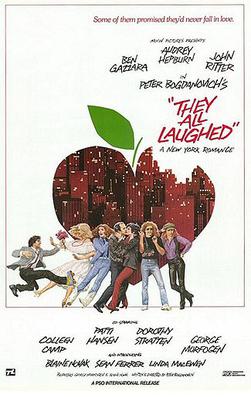
There would, of course, be other romantic comedies. Some would be wonderful. Peter Bogdanovich’s They All Laughed would arrive three years later and become an entirely different kind of classic. Woody Allen continued making brilliant romantic comedies for decades, and Nora Ephron eventually reinvented the genre for a whole new generation. But they would belong to a different era. Heaven Can Wait belongs to the period when movie palaces still ruled the earth.
It’s a film built around stars rather than celebrities, situations rather than premises, character rather than attitude and sentiment rather than emotional messaging. It believed that an audience can simultaneously want to laugh, fall in love with (and admire) beautiful people, enjoy crazy plots and shed a tear without apology. That could be why the movie feels so uncommonly generous.
That title, finally, is almost accidentally perfect. Heaven CAN wait, not because it rejects the concept of a celestial afterlife, but because it understands that earth, for all of its ridiculousness, is where the good stuff is. Football games, beautiful women, loyal friends, silly misunderstandings, crooked millionaires, jealous wives, impossible second chances — and Charles Grodin hiding behind a curtain.
What more could anyone reasonably ask of a rom-com?
Some films carry the burden of cultural importance and want to change the way you see the world. Heaven Can Wait simply wants you to enjoy yourself, and that’s much harder than it looks.
The old Hollywood romantic comedy was never really about plausibility, it was about grace. The grace of stars, the grace of timing, the grace of coincidence, the grace of a story that can be completely preposterous and still somehow touch something deeply true inside us.
In 1978, Warren Beatty, Buck Henry, Elaine May and an absurdly talented ensemble cast somehow managed to make one of the last and best of them.
And Charles Grodin, hiding somewhere behind that curtain, was having none of it.
Movie-crazy from an early age, Milan Paurich grew up in Northeastern Ohio at the tail end of theMovie-crazy from an early age, Milan Paurich grew up in Northeastern Ohio at the tail end of the Movie Palace era. Some of his earliest memories involve sitting in the balconies of downtown “Cathedrals of Cinema” and watching “Mary Poppins,” “In Search of the Castaways” and “The Three Stooges Go Around the World in a Daze” for the first time. Milan ultimately took his incipient cinephilia to N.Y.U. where he graduated with a double major in Cinema Studies and Journalism. Milan has been reviewing films professionally for decades: at daily newspapers, alt-weeklies and on local television stations where his reviews appeared three times every Friday–on two separate channels!–for more than a dozen years. Since 2001, Milan has been a voting member of the Critics Choice Association (Film Branch), and won three individual S.P.J. (Society of Professional Journalists) awards as “Best Critic in Ohio.” Updated weekly, his film/home video reviews currently appear online at: https://movieswithmilanmix989.com/ Movie Palace era. Some of his earliest memories involve sitting in the balconies of downtown “Cathedrals of Cinema” and watching “Mary Poppins,” “In Search of the Castaways” and “The Three Stooges Go Around the World in a Daze” for the first time. Milan ultimately took his incipient cinephilia to N.Y.U. where he graduated with a double major in Cinema Studies and Journalism. Milan has been reviewing films professionally for decades: at daily newspapers, alt-weeklies and on local television stations where his reviews appeared three times every Friday–on two separate channels!–for more than a dozen years. Since 2001, Milan has been a voting member of the Critics Choice Association (Film Branch), and won three individual S.P.J. (Society of Professional Journalists) awards as “Best Critic in Ohio.” Updated weekly, his film/home video reviews currently appear online at: https://movieswithmilanmix989.com/