
Editor’s Note: We all know about Dad jokes — but how about Dad Movies? Freeline Media critic Milan Paurich has his vote for the greatest dad movie ever — and it sure is a sentimental one. Read on!
By Milan Paurich
Field of Dreams
“Dad Movie” isn’t usually a term of critical endearment. It mostly implies a certain kind of earnestness, a fondness for baseball and old cars as well as a tendency toward flannel-shirt wisdom and uncomplicated moral lessons. It presupposes the father who owns exactly one good pair of sneakers, has strong opinions about the weather and regards going to the movies as a perfectly acceptable activity so long as he gets home in time for the 11 o’clock news.
Field of Dreams is, in virtually every sense, a “Dad Movie.” It’s also one of the most beautiful American films about love, memory and regret ever made.
That apparent contradiction is precisely what makes Phil Alden Robinson’s 1989 movie so remarkable. Robinson, who made his feature debut two years earlier with the lovely, largely forgotten In the Mood was not yet a director with a recognizable commercial brand or signature style. What he had, though, was something infinitely more valuable: a feeling for ordinary people caught between the lives they’d imagined and the lives they actually possessed. In the Mood was a romantic coming-of-age story, but Robinson imbued it with unusual tenderness. In Field of Dreams, he discovered the perfect material for his sensibility.
It takes some of the most potentially embarrassing ingredients in popular American fiction — the ghosts of baseball players, a mysterious voice in a cornfield, the lost innocence of childhood, fathers and sons, second chances — and refuses to apologize for them. There isn’t a protective layer of irony or knowing wink to reassure sophisticated viewers that they’re in on the joke. Robinson means every bit of it. And somehow, miraculously, he gets away with it. More than that, he makes its unabashed sincerity feel like a form of courage.
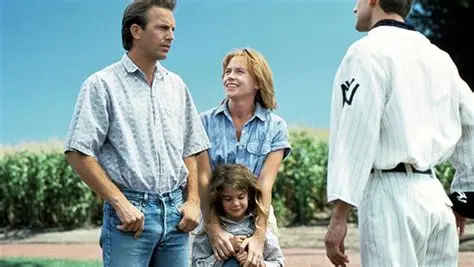
The genius of Field of Dreams is that its supernatural premise is really a way of talking about something completely ordinary. Ray Kinsella, played by Kevin Costner with his uniquely appealing combination of decency and bewilderment, is an Iowa farmer living with his wife, Annie (Amy Madigan), and their young daughter, Karin (Gaby Hoffman). He loves his family, and isn’t unhappy in any obvious sense. Yet somewhere beneath the routines of marriage, parenthood and farming is the nagging suspicion that he’s somehow lost touch with the person he was supposed to become.
Then he hears a voice in his cornfield.
“If you build it, he will come.”
What Ray does next is perhaps the most characteristically Dad thing in the history of American cinema: he builds it. He plows under part of the cornfield and constructs a baseball diamond.
There’s something wonderfully literal about Ray’s response to the mysterious voice. A less Dad-like protagonist might ask what the voice means, seek professional advice, meditate upon it or at least consult Google. Ray gets out the equipment and builds something. His faith takes the form of manual labor.
That’s also a useful clue to Robinson’s approach. He doesn’t treat Ray’s behavior as either madness or sainthood. The camera simply stays with him, allowing the absurdity and earnestness of what he’s doing to coexist. The field becomes an act of faith before Ray even knows what he has faith in.
Eventually of course he discovers that the field has summoned the ghosts of baseball past, including Shoeless Joe Jackson, the Chicago White Sox star whose involvement in the 1919 Black Sox scandal made him one of the great tragic figures in sports history. But the ghosts aren’t really the point. Baseball isn’t even really the point. The point is memory.
And memory, Field of Dreams understands, is inseparable from fatherhood.
Ray’s father, John, has been dead for years. He was a baseball fan, and Ray grew up sharing the game with him. Their relationship was loving but imperfect, as most father-son relationships are. There were things they shared and things they didn’t. Most importantly, there were things Ray came to understand about his father only after his father was gone.
This is where Robinson’s film touches a nerve deeper than mere nostalgia. Childhood gives us our first version of our parents; adulthood gives us the second. When we’re children, our fathers seem like authorities — larger, older, stronger, possessed of answers. When we become adults ourselves, we begin to see the man behind the role. We discover his limitations, fears and disappointments. Sometimes we understand him better, or judge him more harshly. Often we do both. And eventually there comes the terrible realization that whatever remains unresolved between a father and his child will remain unresolved forever. Unless, of course, you happen to have a baseball field in Iowa.
That’s the emotional sleight of hand at the heart of Field of Dreams. The fantasy isn’t really that the dead can return; the fantasy is that we might get one more chance to know them.
Robinson understands that the supernatural elements only work if the emotions remain stubbornly naturalistic. He doesn’t make the ghosts frightening, but familiar. They belong to the same world as Ray’s farmhouse, his family and his cornfield. The extraordinary enters the ordinary almost without changing its temperature. That’s one of the movie’s singular achievements.
The otherworldly mechanism exists to allow something real life almost never permits: the opportunity to encounter a parent not as a memory, but as a person. That’s why Costner is so perfectly cast. He was one of the biggest stars of the period precisely because he could embody decency without turning it into blandness. Costner’s heroes were often Average Joes placed in extraordinary circumstances, but he didn’t play their ordinariness as a deficiency.
Ray isn’t a visionary in the conventional sense. He’s a farmer with a wife, a child, a mortgage and an increasingly inexplicable conviction that he has to build a baseball field. Costner plays him as a man who’s frightened that his life might pass him by without ever figuring out what it was really for.
Robinson doesn’t push Costner toward inspirational heroics, he lets him remain puzzled. Ray isn’t a prophet; he’s simply following a hunch he can’t explain. That modesty makes the miraculous events around him so credible.
It also makes Ray’s quest more than a fantasy; it becomes a midlife crisis story.
By the time we meet him, Ray has already crossed the invisible border between youth and adulthood. He’s become somebody’s father while still carrying unresolved feelings about being somebody else’s son. That’s the peculiar emotional position of parenthood: one generation is looking backward while another looks forward, and the person in the middle is expected to hold everything together.
Ray’s daughter Karin is more than just a cute kid witnessing otherworldly events. She’s part of the film’s generational architecture. She belongs to the future while Ray is trying to make peace with the past. She sees ghosts without requiring explanations because children haven’t yet acquired the adult reflex that says impossible things can’t happen.
Robinson gives Karin an important quality that most movies forget to give children: intelligence. She observes, understands and believes Ray before the adults around him do. Ray has to rediscover that capacity for wonder, but his daughter already possesses it.
This is one of Robinson’s most affecting ideas: adulthood doesn’t necessarily mean outgrowing childhood. Sometimes it means recovering the best things childhood gave us before responsibility, disappointment and self-consciousness taught us to suppress them.
That’s where James Earl Jones enters the story, and his stately presence gives “Field of Dreams” an elevated dimension that keeps it from becoming just an exercise in filial sentiment. Jones’ Terrence Mann is a reclusive writer embittered by a world that’s bulldozed the ideals of his youth. When Ray first approaches him, Mann is skeptical of the whole enterprise. Yet once he sees the baseball field, something changes.
Through Mann, baseball becomes a metaphor for a vanished America. Not the historical America of political reality which was never as innocent as nostalgia would have it, but the America of remembered childhood. The ballpark becomes a place where generations can meet, where the dead can briefly reappear and where the pleasures of the past can be experienced without pretending that the past itself can be restored.
Mann understands the melancholy behind the rhetoric. His famous speech about baseball and America could easily have become grandiose. Instead, Jones gives it the weight of a man who’s spent years mourning something he can’t quite put his finger on.
And Robinson wisely allows Mann’s soliloquy to breathe. He doesn’t smother it with visual effects or oversell its sagacity. He lets Jones’ sonorous voice, the majestic field and the celestial ballplayers carry the emotion.
Robinson’s filmmaking style is almost deceptively classical. It doesn’t call attention to itself by reminding us that we’re watching something Important. Instead, he builds an atmosphere in which the ordinary and otherworldly gradually become indistinguishable.
The cornfields, the farmhouse, the baseball diamond and the nighttime conversations between Ray and Annie are all staged with a kind of pastoral simplicity. Robinson makes Iowa feel simultaneously like a real place and a font of memory. The film’s magic depends upon the world feeling solid enough to make the impossible seem corporeal.
Robinson’s treatment of Archie “Moonlight” Graham (Burt Lancaster) deepens that theme even further. Graham is the baseball player who appeared in a single major-league game in 1905, but never got the opportunity to bat. In the present day, he’s an elderly doctor who spent his life helping other people.
Graham isn’t haunted by what he did, but what he didn’t get the chance to do. His backstory introduces one of the movie’s most quietly profound ideas: that regret isn’t confined to spectacular failures. Sometimes an entire life can be shaped by a door that almost opened.
Graham never became the baseball player he dreamed of becoming, but he did become a doctor and lived a meaningful life. The film doesn’t suggest that his life was somehow incomplete simply because he never achieved his youthful dream. Instead, it asks us to consider the strange coexistence of fulfillment and regret.
Robinson brings the same patience to Graham’s story that he does to Ray’s. The movie repeatedly pauses to ask what a life means — not in terms of achievement, but in terms of possibility. What did we dream of becoming? What did we actually become? And are those two things necessarily as far apart as they sometimes appear?
This is another distinctly Dad-like anxiety. Fathers are forever wondering whether they made the right choices. Whether they worked too much or too little. Whether they sacrificed enough, or sacrificed the wrong things. Whether they encouraged their children properly, or discouraged them without realizing it. Whether the life they built was the life they actually wanted.
Field of Dreams doesn’t provide answers to those questions, it offers grace.
And then, after all the ghosts, baseball and talk about dreams, the film finally reveals what Ray’s field was really built for when his father walks out of the cornfield. John Kinsella (Dwier Brown) appears not as an apparition intimating some cosmic truth, but simply as a young man in a baseball uniform.
And this is where the movie becomes something more complicated and moving. Ray isn’t given an opportunity to interrogate his father about the past. He doesn’t get to demand explanations. There’s no grand reconciliation scene in which John confesses his mistakes and Ray forgives him.
Instead, his father asks the simplest possible question.
“Is this your daughter?”
Ray says yes.
John looks at Karin.
And for a moment, the three generations exist together.
The father, the son and the granddaughter he never lived long enough to know.
It’s an extraordinarily economical image, and Robinson trusts its simplicity. The film has spent two hours telling us that the past can never truly be recovered, and then, for one fleeting moment, it gives Ray exactly what he’s lost.
Not his childhood, not his father as he remembers him, but his father as a man.
And then comes the line that’s made grown men weep for nearly four decades.
Ray asks John if he’d like to have a catch.
Of course he would.
What makes the scene so devastating is its restraint. Ray has spent the entire movie pursuing a miracle, and when the miracle finally arrives he doesn’t ask for anything extravagant. He doesn’t ask his father to stay. He doesn’t ask why he died. He doesn’t demand an explanation for the mysteries of his childhood.
He simply asks if they can play catch.
Robinson’s refusal to overplay the scene was remarkably intuitive. By simply allowing it to happen, it becomes vastly more intimate: a private memory that would be shared by millions of strangers in the dark.
That’s the most perfect expression of fatherhood Field of Dreams could possibly have devised. Fathers and sons don’t always communicate through declarations. Sometimes they communicate through the things they do together. A baseball glove; a backyard; a game of catch after dinner.
The ball travels back and forth between them, carrying with it everything they never had the chance to say.
Ray is a father now, but for this brief moment he’s also a son again.
There is no larger miracle.
The film doesn’t need one.
That’s why Field of Dreams is the greatest Dad Movie ever. Not because it flatters dads, and certainly not because it presents fatherhood as uncomplicated. Quite the opposite actually. It understands that fathers are imperfect men asked to perform an impossible role: to become the adults their children will remember while they’re still trying to figure out how to become adults themselves.
It understands that when sons eventually become fathers, they begin to see their own fathers differently.
It understands that the past can’t be repaired.
But it also understands that the past can sometimes be reinterpreted.
And perhaps that’s the film’s deepest wisdom.
We can’t go back and change what happened with our parents. We can’t become children again. We can’t recover the years that disappeared while we were busy growing up.
What we can do is carry something forward.
Ray carries his father’s love of baseball into his own relationship with Karin. The field becomes an inheritance—not merely of a sport, but of memory itself. Ray has received something from his father that he can now pass down to his daughter.
At their best, that’s what families are: imperfect chains of memory and affection extending backward and forward through time.
The movie knows that this can sound hopelessly sentimental, and it simply doesn’t care.
That could be the bravest thing about it.
There’s a fashionable tendency to regard sentimentality as inherently suspect, as though sincerity were evidence of artistic naiveté. Field of Dreams makes a persuasive case for the opposing viewpoint: sentimentality becomes false not when it’s excessive, but when it’s unearned.
This film earns it.
And Phil Alden Robinson deserves much of the credit for understanding exactly how much emotion the material could bear without collapsing under its own weight. His direction is its secret sauce: gentle but not inert, lyrical but not precious, emotionally direct without being coercive. He knows when to push and, more importantly, when to pull back.
Looking at Robinson’s I.M.D.B. profile, it’s tempting to regard Field of Dreams as the moment when everything came together, and in a sense it was. In the Mood remains a charming, little seen work of youthful romantic idealism that now seems like a fascinating prelude to what he’d accomplish two years later. After Field of Dreams came the smart caper comedy Sneakers (1992) followed by a filmography that never quite returned to the same extraordinary conjunction of material, actors and sensibility.
That makes Field of Dreams feel less like the beginning of a signature career than its summation.
But perhaps that’s fitting.
Some filmmakers spend a lifetime circling their defining subject without ever finding it. Robinson found his very early: the relationship between memory and possibility, between the person we were and the person we became, between the dreams we abandoned and the people we loved.
He found it in a cornfield.
And he found the perfect cinematic form for it in the most unlikely combination imaginable: baseball, ghosts, fathers and sons.
Perhaps that’s why Field of Dreams has endured even as the culture around it has changed so dramatically. Baseball has become more complicated as a cultural institution. The America it evokes has become harder to romanticize. The conventions of the inspirational sports movie have been thoroughly parodied and recycled.
Yet the final scene remains immune to the vagaries of fashion because nobody has ever stopped wanting one more chance.
One more conversation.
One more embrace.
One more afternoon.
One more game of catch.
The greatest Dad Movie understands that the deepest fantasies of fatherhood have remarkably little to do with winning. They have to do with being remembered. With knowing that something of you will survive in the person you helped raise. With the hope that, despite all your mistakes and failures and silences, your child will someday look back and understand that you loved them.
Field of Dreams turns that hope into a ghost story, a baseball film and a meditation on America, memory and the passage of generations.
Then finally, with absolute guilelessness, it reduces everything to a father and son standing on a baseball field together.
The son has become a father.
The father has become a memory.
For a few minutes, neither has to be anything except himself.
Ray throws the ball.
His father throws it back.
And perhaps that’s what the title has really been telling us all along.
The field isn’t where dreams comes true.
The dream is getting the chance to play catch again.
Movie-crazy from an early age, Milan Paurich grew up in Northeastern Ohio at the tail end of the Movie Palace era. Some of his earliest memories involve sitting in the balconies of downtown “Cathedrals of Cinema” and watching “Mary Poppins,” “In Search of the Castaways” and “The Three Stooges Go Around the World in a Daze” for the first time. Milan ultimately took his incipient cinephilia to N.Y.U. where he graduated with a double major in Cinema Studies and Journalism. Milan has been reviewing films professionally for decades: at daily newspapers, alt-weeklies and on local television stations where his reviews appeared three times every Friday–on two separate channels!–for more than a dozen years. Since 2001, Milan has been a voting member of the Critics Choice Association (Film Branch), and won three individual S.P.J. (Society of Professional Journalists) awards as “Best Critic in Ohio.” Updated weekly, his film/home video reviews currently appear online at: https://movieswithmilanmix989.com/


