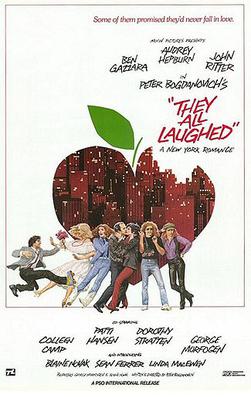
Editor’s Note: Peter Bogdanovich’s 1981 comedy They All Laughed barely made it into cinemas, and was marred by the tragic murder of one of its performers, Dorothy Stratten. Freeline Media critic Milan Paurich looks back at the film, which he thinks is ripe for rediscovery as of the most incandescent romanticized comedies ever made in New York City. Read on!
By Milan Paurich
They All Laughed
New York City has been variously portrayed on screen as a battlefield, a nightmare, a playground, a proving ground and a place where nobody can hear themselves think. But in 1981’s They All Laughed, Peter Bogdanovich saw something different. He envisioned Manhattan as a conduit for bringing people together. Cars, cabs, sidewalks, restaurants, apartment buildings, record stores and chance encounters all seem to be nudging lonely people toward one another. That tension is what makes it such an extraordinary achievement.
Describing the film as a romantic comedy is as reductive as calling The Searchers a western or The Godfather a gangster yarn: it doesn’t truly convey what he accomplished here. This is a movie that seems to be drifting along without much plot because Bogdanovich was interested in something more elusive than narrative — the way people wander into relationships almost without realizing it.
Two private detectives are hired to follow women whose husbands suspect them of infidelity. The irony is that the detectives become emotionally entangled with the women they’re supposed to be tailing.
Ben Gazzara’s John is assigned to follow Angela (Audrey Hepburn) while John Ritter’s Charles trails Dolores (Dorothy Stratten). Soon enough, surveillance becomes attraction, attraction becomes romance and the professional act of observing other people’s lives turns into a rather desperate attempt to understand one’s own.
Bogdanovich wasn’t terribly concerned about the nuts and bolts of detective work. He uses the private eye setup as a kind of MacGuffin: a reason for these people to keep observing one another, crossing paths and showing up in the same places. Bogdanovich was quite candid about that in an interview. The detective story, he said, was merely something to “hang a hat on.” What most interested him was the relationships, and that’s exactly how it feels. The plot is a clothesline; the characters are the clothes; the city is the wind; and the whole thing keeps moving.
That’s one reason They All Laughed feels so unlike most Hollywood rom-coms. There’s no aggressively engineered meet-cute, no succession of screenwriter-designed misunderstandings, no third act revelation that neatly informs everyone that they’ve been in love all along.
People simply spend time together. They talk, drive, walk, flirt, wait, change their minds, make mistakes and fall in love. It’s astonishing how radical that can feel.
Bogdanovich was returning to the old Hollywood romantic comedy, but he wasn’t trying to reconstruct it in a studio backlot. He wanted the feeling of Golden Age Hollywood without the outdated tropes. His New York is recognizably contemporary, yet possesses the almost magical looseness of a 1930’s comedy. People are constantly in motion, yet nobody ever seems to be in a hurry. That contradiction gives the film its charm.
Robby Müller’s photography is crucial. The city isn’t presented as a collection of tourist attractions, it’s a lived-in New York: streets, storefronts, cabs, apartment windows and passing faces. Bogdanovich doesn’t announce the city as a star, he lets it become one. Manhattan isn’t just scenery here, it’s a romantic accomplice. A cab ride can become an encounter. A surveillance assignment can become a date. A walk across town can become an adventure. A person glimpsed through a window can become the person you spend the rest of the night thinking about. And because Bogdanovich keeps the camera moving with his characters, the movie acquires the sensation of being discovered rather than plotted.
Gazzara’s John is more seasoned and emotionally complicated than Ritter’s Charles. He has the weary confidence of a man who’s been around the block enough times to know that romance is usually a bad idea, yet young enough to keep falling in love anyway.
Audrey Hepburn is almost impossibly lovely here, but Bogdanovich does something smart with her beauty. Rather than turn Angela into an icon, he lets her be a woman. Hepburn’s performance is relaxed, playful and wonderfully naturalistic. Angela isn’t some ethereal Hepburn fantasy who descended into Manhattan from another film (e.g, Blake Edwards’ Breakfast at Tiffany’s). She has a sense of humor, curiosity and a slightly mischievous intelligence. Her attraction to John feels plausible because Hepburn makes Angela seem genuinely interested in him, and Gazzara meets her there. Their scenes together have the lovely uncertainty of two grown-ups who know enough about life to understand that falling in love again can be both wonderful and inconvenient.
That’s part of the movie’s secret. Nobody here is innocent, but everyone is hopeful.
Ritter’s Charles is John’s younger, more farcical counterpart. Ritter had an extraordinary gift for physical comedy, and Bogdanovich knew exactly how to use it. Charles is constantly moving a little too fast, falling over things, misconstruing situations and behaving as though his body has received instructions his brain hasn’t yet processed. Yet Ritter never makes him a clown. His romantic vulnerability gives the character’s comic acrobatics a genuine sweetness.
It’s impossible to discuss They All Laughed without acknowledging the tragedy that surrounds Dorothy Stratten. She was murdered in August 1980, shortly after filming was completed. The movie subsequently became entangled with the circumstances of her death, and Bogdanovich’s determination to get Stratten’s final screen role before an audience.
But there’s a danger in allowing the tragedy to become the entire meaning of her performance. Stratten has an extraordinary screen presence. Not because she appears fully formed as an actress, but because she seems completely at ease in front of the camera. There’s an openness to Stratten’s performance that the film needs: she’s young, funny, flirtatious and alive. Watching her is painful precisely because Bogdanovich refuses to make Stratten seem anything but alive.
Colleen Camp brings such aggressive comic energy to country western singer Christy that she seems capable of blowing the door off whatever room she enters. And Patti Hansen, as John’s favorite cab driver, is funny without ever seeming to “play” comedy.
Yet Bogdanovich doesn’t isolate any of their performances; he lets them overlap. That’s where the movie’s real craft becomes visible. People are always entering and exiting, passing one another, following one another, missing one another by a millisecond. The detective premise gives Bogdanovich an excuse to construct elaborate patterns of movement, but he never makes the choreography feel mechanical. In most romantic comedies, characters move because the plot requires them to. In They All Laughed, they move because, well, people move.
They go out, come home, take cabs, walk dogs, shop, visit friends. They have nowhere particular to go, and suddenly the ordinary becomes romantic.
That’s why the film’s title is so perfect. It comes from a Gershwin song, but also suggests a kind of affectionate resignation. People have always laughed at romantic fools who believe they’ve found happiness by pursuing impossible love affairs. Bogdanovich doesn’t mock that impulse, he celebrates it. The movie’s philosophy is almost childlike in its optimism: people are worth pursuing. Not because they’re perfect, but because they’re interesting and might even surprise you. You might even discover something about yourself by getting to know them. And sometimes that person will turn out to be the special someone you were always looking for.
That last idea gives the detective premise its real resonance. The characters spend the entire film watching other people. But the deeper joke is that they don’t really understand what they’re seeing. They think they’re gathering information, but they’re really falling in love. Surveillance becomes courtship; observation becomes intimacy. The private eye becomes the lovestruck swain, and New York becomes the great laboratory in which it all happens.
There’s something wonderfully democratic about Bogdanovich’s Manhattan. Everyone is potentially part of someone else’s story. The cab driver, the detective, the country singer, the millionaire’s wife, the young woman walking down the street. Nobody knows what role he or she is playing until the movie catches up with them.
That looseness is one reason They All Laughed can feel almost European. It has the relaxed, observational quality of a film more interested in behavior than narrative mechanics. But there’s something distinctly American underneath it, too. The movie believes in mobility. You can leave one place and go somewhere else. You can change your mind, meet somebody new, take a different cab or turn around and begin again.
That could be why the film feels so deeply connected to Bogdanovich’s earlier work, even while superficially different. The Last Picture Show is about people discovering that the world they inherited is disappearing. Paper Moon is about two people who discover an unexpected affinity in the middle of a Depression-era America that offers them very little security. Saint Jack is about loneliness and companionship in a completely different cultural environment. They All Laughed is more optimistic: it’s about people who haven’t given up yet.
The movie was released at precisely the moment when Bogdanovich’s career had become increasingly problematic. The Hollywood that embraced him as the wunderkind behind The Last Picture Show, What’s Up, Doc? and Paper Moon had changed. They All Laughed was hardly a conventional commercial proposition, and after 20th Century Fox cancelled its planned release, Bogdanovich bought it back and attempted to distribute it himself. The effort was financially ruinous. It became, in effect, a lost film. And that’s almost unbearably ironic because They All Laughed is a movie about people trying not to lose one another. Its history became tangled with loss: Stratten’s death, Bogdanovich’s financial collapse, the film’s commercial failure, its disappearance from the cultural conversation.
But the movie resists all that. It’s too alive; it keeps moving; it keeps flirting; it keeps laughing. That’s why its reputation has grown over time. Even critics who were lukewarm in 1981 have joined later admirers who saw what Bogdanovich was attempting: a deliberately loose, deeply personal romantic comedy that valued atmosphere, character and human connection over conventional narrative payoff.
The film’s greatest achievement may be that it makes romantic uncertainty pleasurable. Most rom-coms treat uncertainty as an obstacle, but They All Laughed treats it as the experience. You don’t know what’s going to happen next, and neither do the characters. That’s the fun, and its overarching sadness, because love is always a bit like surveillance.
You watch the other person, try to interpret their gestures, wonder what a glance means, remember something they said three days ago, construct theories and wait for the evidence. Bogdanovich understood that. He also understood something else: the best romantic movies aren’t necessarily the ones in which love conquers all. They’re the ones in which people remain willing to believe in love despite knowing better. They All Laughed is a film about adults who know that relationships can hurt, that people can disappoint and that desire complicates everything.
Bogdanovich isn’t pretending that life is uncomplicated, he’s saying that complication is part of the pleasure. The city is crowded, relationships are messy, timing is imperfect. Everybody is following somebody, and being followed by someone else. Yet somehow, amid all that confusion, two people can look at one another and think: Maybe.
That tiny word is the emotional core of They All Laughed. Maybe this person; maybe this time; maybe this city; maybe love. The film never insists on certainty; it doesn’t need to. It simply keeps moving through New York City, buoyed by music, sunlight, conversation and the possibility that the next person who walks down the street might change everything.
That’s why They All Laughed feels lighter than air. And why, beneath all that lightness, it hurts. Peter Bogdanovich made a lot of movies about people trying to hold on to something that was disappearing. Here he made one about people who haven’t stopped looking for something to hold on to. It may be the most romantic film he ever made, as well as his most vulnerable. And it may be the most beautiful New York romantic comedy nobody saw when it was supposed to be seen.
Bogdanovich’s joke was never on the lovers, it was on anybody who thought they knew where love was going. In this movie, love is always turning the corner.
Movie-crazy from an early age, Milan Paurich grew up in Northeastern Ohio at the tail end of the Movie Palace era. Some of his earliest memories involve sitting in the balconies of downtown “Cathedrals of Cinema” and watching “Mary Poppins,” “In Search of the Castaways” and “The Three Stooges Go Around the World in a Daze” for the first time. Milan ultimately took his incipient cinephilia to N.Y.U. where he graduated with a double major in Cinema Studies and Journalism. Milan has been reviewing films professionally for decades: at daily newspapers, alt-weeklies and on local television stations where his reviews appeared three times every Friday–on two separate channels!–for more than a dozen years. Since 2001, Milan has been a voting member of the Critics Choice Association (Film Branch), and won three individual S.P.J. (Society of Professional Journalists) awards as “Best Critic in Ohio.” Updated weekly, his film/home video reviews currently appear online at: https://movieswithmilanmix989.com/