
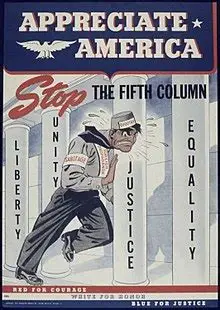
Editor’s Note: Hitchcock used to say that a thriller is only as good as its villains. Freeline Media critic Mike Fried looks back at some of his favorite films featuring perhaps the greatest (if nastiest) villains of all time: the Nazis! Read on!
By Mike Fried
While I hate Nazis — and all of my friends do as well — they are terrific cinematic bad guys. I mean, would Raiders of the Lost Ark have been the same without Major Dietrich saying “I am uncomfortable with the thought of this — Jewish ritual.” Or would Last Crusade have been as good if Indiana Jones himself hadn’t said “Nazis. I hate those guys.”
Now imagine it’s not the 1980s and imagine it’s the lead up to World War Two or after the beginning of the War when the threat is not imagined or historical but is something actually happening. The distrust among people, the pure paranoia that Nazism and Fascism begot were as heavy as a heart attack and as worrisome.
The fifth column is a group of people who undermine a larger group or nation from within, usually in favor of an enemy group or another nation. The activities of a fifth column can be overt or clandestine. Clandestine fifth column activities can involve acts of sabotage, disinformation, espionage or terrorism executed within defense lines by secret sympathizers with an external force.
Several filmmakers, including Alfred Hitchcock, Carol Reed and Michael Powell all addressed this threat in the lead-up to and during wartime in several classic films from the 1930s and 1940s.
THE 39 STEPS
4.5/5
Richard Hannay meets a woman at a music hall and she invites herself back to his apartment. She is killed and he must go on the run, accused of her murder, while trying to stop a dastardly secret spy organization achieve its evil ends.
It should be noted that the character of Richard Hannay was featured in 5 books by John Buchan. One of the early readers was a child named Ian Fleming who once wrote “Without Hannay, there would be no James Bond.”
There’s no question that Sir Alfred served up the better version of the story. Even though the 1959 version was mostly shot on location in Scotland and Hitch’s was mostly filmed on a soundstage, the differences are palpable.
From camera angles and closeups to a non-reliance on humor but rather suspense this movie is one of Hitchcock’s best. Just the transition from the maid finding the body and opening her mouth to scream but the quick cut to the steam locomotive whistle is so jarring and effective. And unlike the 1959 remake, Hitch gets right into British rowdiness that suffuses that opening music hall scenes, rather than using the maguffin of a baby carriage as a distraction.
And in a scene that The Fugitive would copy some 60 years later, our hero hides from the police while marching in a parade.
Robert Donat and Madeleine Carroll are perfect together and the humor that Hitchcock evinces from them while they are handcuffed is especially terrific in the stocking scene where Donat holds her sandwich as she pulls off her stockings with the sandwich following the camera down the legs.
And the comedy is there but it’s much more understated and nod nod wink wink than the remake.
And it comes to a crashingly splendid finale at the London Palladium in Soho where Hannay finally ties up loose ends.
The only questions that Hitchcock leaves unanswered is “what causes pip in poultry” and “how old is Mae West”
WATCH IT!
NIGHT TRAIN TO MUNICH
5/5
A Czechoslovakian inventor escapes to England but his daughter is kidnapped apes and sent to a concentration camp. His daughter escapes to England after being assisted by another refugee only to be kidnapped by the Gestapo along with her father and sent back to Germany. You see, dad has invented a superior armor plating that the Nazis want to get their hands on. A British secret service agent follows them, disguised as a senior German army officer pretending to woo the daughter over to the Nazi cause.
Carol Reed’s terrific wartime film is unfairly compared to Hitchcock’s The Lady Vanishes. Yes, there are some similarities in a couple of characters and a carryover of the leading lady but that’s basically where the similarities end.
Margaret Lockwood and Rex Harrison (in his first lead role) shine in this tale of cross and double cross during World War Two. Lockwood’s Anna Bomasch especially as she realizes that she has been double-crossed by Henreid’s, Karl Marsen, an ostensible refugee in the same concentration camp in which she is interned who turns out to be a Gestapo agent. Rex Harrison’s Dickie Randall is undercover as a song and dance man and is remorseful when Anna is sent back to the control of the Third Reich. He plays the role of Dickie with great panache and full lines of bullshit as befits a master spy.
Sure, there has to be a leap of imagination in this film. The fact that Harrison’s Dickie Randall is readily able to infiltrate the Nazi Command as a Major Herzoff requires a leap of faith. Aside from being g given the proper papers there is no basis for which the audience to really believe this falsity. Who is this Major Herzoff? Why doesn’t the Nazi higher-ups question his bona fides? For a lesser director, this would be a problem. But for Carol Reed it is a mere piffle.
He directs this film with such an effervescent pacing that the logical dissonance doesn’t matter. The movie, at 90 minutes long, moves along at breakneck speed, taking potshots at the Nazis (who’s complaining?) and is full of suspense because of Karl Marsen’s suspicions about Major Herzoff.
Interestingly, Paul Henreid (under his real name Paul Von Hernreid) plays an undercover Nazi spy attempting to round people up for the Gestapo. Two years later, he played a character in desperate flight from the Nazis: Victor Laszlo in the best of the anti-Nazi films, Casablanca.
Basil Radford as Charters and Naunton Wayne as Caldicott reprise their roles as the cricket loving pair from The Lady Vanishes and they inject a nice bit of humor – and suspense – on the title train. Interestingly, the pair would play the characters in several more films. Their discussion about one of them losing their golf clubs is priceless. But their roles are absolutely crucial to the story.
It is an extraordinarily fun spy picture that rewards repeated viewings.
WATCH IT!
49TH PARALLEL
4.5/5
In World War Two, a German U-Boat sinks a Canadian vessel and then seeks refuge in Hudson Bay, where it is sunk by Royal Canadian Air Force bombers. Six German survivors head for the United States which, at the time, was neutral. The Germans steal a plane but it crashes and the German soldiers are welcomed into a Hutterite community, which they believe will be sympathetic to the Nazi cause given their German origins. They are wrong.
This Academy Award winning film – Best Story which was also nominated for best Picture and Best Original Screenplay – was fully intended to be a piece of British propaganda that would force America to change its position on neutrality. Whether it had the effect or not is doubtful as it was not released in the USA until March of 1942, three months after Pearl Harbor. The story itself plays out as a wartime Nazi version of Agatha Christie’s And Then There Were None. And it goes out of its way to show how good and true the Canadian people were during the Second World War.
This is truly one of the best World War 2 movies because the effect that it had. Even without Pearl Harbor, the film took pains to illustrate the Nazi savagery.
It also takes pains to point out how the uninformed may have perceived the Germans. When Johnnie, a fur trapper who has spent a year in the frontier trapping, is told about the war he is incredulous that the Germans would be doing this because they are the same as us.
In fact, the one really bad overwrought performance in the film is – believe it or not – from Sir Laurence Olivier whose cartoonish French Canadian trapper is purely caricature, even more so than his late career turns in Marathon Man and The Boys from Brazil. I don’t know what he or director Michael Powell were thinking. It almost seems as if John Cleese’s French accent in Monty Python and the Holy Grail was modeled after Olivier’s.
But the rest of the cast is absolutely outstanding. Eric Portman as the evil Lieutenant Hirth who tries to get Johnnie to read Mein Kampf as the fuhrer will liberate the French. But Johnnie has none of it. Hirth is a master of deception. He knows that the men must discard their informs and steal civilian clothes if they are going to reach their destination. Niall McGinnis is wonderful as the one Nazi, Vogel, who has some semblance of heart but not for long. When a mortally wounded man wants his rosary beads, Hirth scoffs at this. But after Hirth leaves Vogel gives the man his rosary beads but a moment later he knocks a picture of King George VI off the wall and uses his bayonet to scrawl a swastika into the wall. Yet, at the Hutterite community, Vogel uses his baking skills to improve the Hutterite bread and is welcomed into the community.
Glynis Johns, in a very early performance, is wonderful as Anna, the 16 year old member of the community who caters to the men, not knowing they are Nazis. But when she finds out they are Nazis, she threatens to turn them in.
The always excellent Anton Walbrook is, you guessed it, once again excellent as Peter the leader of the Hutterite community. When Lieutenant Hirth tries to indoctrinate the Hutterites, he is rebuffed quite forcefully by Peter: “Yes most of us are Germans, our name is German, our tongue is German, our handwritten books are in German scripts, but we are not your brothers. Our Germany’s dead.”
Leslie Howard and Raymond Massey round out the cast as a writer and an AWOL Canadian soldier. As the remaining Nazis burn Howard’s paintings and manuscripts, he and his friends chase them. And Massey’s Brock is humorously pivotal in the outing me of the film.
And that is the genius of this film. With the exception of Portman, all of the actors in this film really have secondary supporting roles, but all of them are used for maximum impact and advantage.
And it makes this film one of the best of the World War Two era.
“Two Nazis against 11 million Canadians”
WATCH IT!
SABOTEUR
5/5
Barry Kane is just an ordinary guy. He works in an aircraft factory. He’s having lunch. He bumps into a suspicious looking guy, knocking a letter out of his pocket but thinks nothing of it. When a fire breaks out, he and his friend rush to the rescue. He hands his friend a fire extinguisher and when the friend uses it the friend is engulfed in flames. Kane believes the suspicious looking guy, Fry, is responsible but no one by that name works at that plant. Kane becomes wrongly accused and the target of a nationwide search. Kane remembers the address on the letter and it belongs to a man named Tobin who is working with a group of saboteurs which includes Fry. Kane escapes Tobin and takes refuge with a blind man and his niece a woman named Patricia Martin. She believes he is guilty and tries to turn him in but he keeps her close and she is on the run with him.
This is in my top 5 Alfred Hitchcock movies (North by Northwest, Vertigo, Rear Window and The Birds precede it) and while I might be the only one who has put it in his top 5, I think it is one of the best pieces of wartime propaganda and as Hitchcock himself said they he “wanted the boy and girl in Saboteur to suggest the thrilling importance of unimportant people” meaning that everyone can make a difference in the fight against evil.
The film was different from other Hollywood movies of the time in that it used a lot of location settings, something that would become a Hitchcock trademark. Whether it was Lone Pine, California (“my tree!!!”) or New York City. In fact one of the best shots in the movie is a cheat by Hitchcock. The S.S. Normandie had caught fire and fallen over on it its side in New York Harbor and people thought it was German sabotage – I remember my mom showed me photos she had taken of it as an 11 year old. Well, Hitchcock said to hell with permits and he got in a car with a camera and drove past the ship and when bad guy Fry ( a great name for a band) see the ship laying on its side he just gives a little smile, as if the rumors of sabotage were true, as if this was one of his group’s doings.
Bob Cummings was not a great actor but he rose to the occasion for this film playing Kane as an upright, tried and true but desperate man who was also smart. Priscilla Lane who is known to most audiences as Cary Grant’s love interest in the seminal Halloween comedy Arsenic and Old Lace plays the damsel in distress quite well and prices the she is as smart as Kane and that looks and smarts can go together.
Otto Kruger’s Tobin is that prosperous bad guy, man well known in his community, well-off, charitable and subtly evil. Behind his hearty smile lies malevolence. But it is Norman Lloyd’s evil Frank Fry that resounds majestically. He’s not a German, he’s an American and before he grew up to be kindly Dr. Auschlander on St. Elsewhere, Lloyd had a sharp, angular ferret-like face that made Fry just seem evil without even talking. It was his first theatrical feature film and he would be making movies for another 73 years.
The movie itself is another film in a long line of Alfred Hitchcock films that would culminate with his greatest work, North by Northwest, about an innocent man wrongfully accused and chased all over, leading to a climactic scene – in North by Northwest it was in Lincoln’s nose and in this film it is from the heights of the torch held high above the head of the Statue of Liberty. Even Hitchcock confirmed that North by Northwest was a remake of this film when he discussed it with Francois Truffaut.
There is an outstanding scene filmed in Radio City Music Hall as well as a climactic scene filmed at the Navy Yard during the launching of a ship. The entire Statue of Liberty sequence was filmed in a lookalike set used to recreate Lady Liberty’s torch and the visual effects at the end of the film are nothing short of startling. And of course it represents a battle for Liberty.
Time Magazine raved about the film contemporaneously but drove home the point that the filmmakers intend to “warn Americans, as Hollywood has so far failed to do, that fifth columnists can be outwardly clean and patriotic citizens, just like themselves.” In fact, Hitchcock goes to great pains to paint the authorities as being out of their element and ordinary Americans including g the circus people and Murray Alper’s truck driver to be the ones who believe in Kane’s innocence.
There is a slight reference to this movie in the Coen Brothers’ The Hudsucker Proxy and it has to do with the quality of suit tailoring – it is quite a fun scene to catch.
This is a terrific wartime film but it is set on our shores. And it plays out like it could theoretically happen. How many times has someone said “I was just a patsy.”
WATCH IT
Fun fact: The set used as the ranch house of Charles Tobin (Otto Kruger) was used as the home of the Brenners for another Sir Alfred Hitchcock movie, The Birds (1963). It originally was a leftover set from a Deanna Durbin movie shot on the Universal backlot.
FOREIGN CORRESPONDENT
5/5
“To those intrepid ones who went across the seas to be the eyes and ears of America… To those forthright ones who early saw the clouds of war while many of us at home were seeing rainbows… To those clear-headed ones who now stand like recording angels among the dead and dying… To the Foreign Correspondents – this motion picture is dedicated.”
Hitchcock’s Lee to overseas journalists covering news in wartime is one of his best.
It’s 1939 and the editor of the New York Morning Globe sends the patriotically named crime reporter Johnny Jones – under the alias of Huntley Haverstock – to London to report on the European situation. He is to meet with a Dutch diplomat Van Meet who evades his questions and then is smitten by a woman, Carol Fisher, whose father is the head of the Universal Peace Party. Jones is sent by his editor to cover Van Meer’s next appearance where Van Meer is assassinated. He runs into Carol again along with a reporter friend Scott Ffolliott. while he sends them to look for the police, Jones investigates and inside a windmill, Jones finds Van Meer, alive but drugged, a substitute having been used. And from that point on, the chase is on.
Just a terrific movie that, in its own way – like Saboteur 2 years later- anticipated North by Northwest almost 20 years in the future. Bad guys hiding the evidence to make the main character look like a loony, the hero escaping his apartment and walking on a ledge of a building to another apartment. And other touches.
Top tier Hitchcock that called out the Nazis at the same time as Chaplin – but both way after the Three Stooges in “You Nazty Spy”.
Led by Joel McCrea and Laraine Day, this movie crackles as with McCrea as a newspaperman who believes he is on to a conspiracy relating to what he believes is a fake assassination of a diplomat is putting mortal danger. McCrea is in top form so much so that Hitchcock wanted to use him for his follow up Saboteur but he was unavailable. He has rugged good looks and a terrific fun loving devil-may-care attitude that belies his intelligence. Laraine Day is wonderful as Carol, the girl with whom he wants to spend the rest of his life with.
The film has some nice supporting turns from Robert Benchley, who wrote his own lines, as a fellow Globe reporter stationed in London who is being pushed aside because of his drinking and womanizing. He provides the film’s witty comic relief. Edmund Gwenn plays a bodyguard who is the total 360 degree opposite of his Kris Kringle (“I ain’t lanky, but I’m quick”). And perennial bad guy Eduardo Cianneli is absolutely terrific as one of the lead bad guys, Krug. Ever since he played the evil “Guru” in Gunga Din you can tell that his angular face and scowl would be used to portray menace. And he does it so well here. Herbert Marshall, as Carol’s father, is excellent especially as his allegiances are known early but it’s his daughter that he cares about.
But it is George Sanders’ Scott Ffolliott that works so well in this film. Sanders had a great career playing both good guys and bad guys and his well-bred manners often covered up which one he was playing. And the same thing happens here. We don’t know Ffolliott’s intentions and that adds to the character’s air of mystery. This was a Hitchcock casting coup but its Sanders all the way in a great piece of acting misdirection.
Made for an astonishing $1.5 million in 1939 (that’s nearly $40 million in 1940) Hitchcock created some extraordinary set pieces in this film. He re-created a town square in Holland for a scene that took place during a rainstorm and which required drainage as well. And that PLANE CRASH!!!!!! It’s a set piece that cost nearly one quarter of the film’s budget and you can tell how wonderfully it is produced with extraordinary visual effects.
The attention to detail is terrific and it comes through in the final product – 1940 was Hitch’s year – as this film and Rebecca were both nominated for Best Picture with Rebecca winning. The movie – as most excellent Hitchcock films do – combines intrigue and humor in a terrific Oscar nominated script- and even though it did not win an Oscar it evidently had one fan – Nazi chief propagandist Goebbels who said the movie was “”a masterpiece of propaganda, a first-class production which no doubt will make a certain impression upon the broad masses of the people in enemy countries”.
In short, Fuck the Nazis (old and new!) and WATCH IT
5/5
Michael Fried has no formal training in movies, except having watched over 26,000+ movies — if not more — in his 60-plus years on this planet, starting with Goldfinger as his first cinema experience. He knows what he likes and he knows what he doesn’t like, and it’s quite often different from the conventional wisdom. He knows that the best franchise is Godzilla and he loves action movies and comedies. He has not been nominated for any awards except some boring insurance awards which has no applicability to movies (with the possible exceptions of Billy Wilder’s Double Indemnity and John Cassavettes’ Big Trouble). He is part of a team that won the 1980 SUNY Albany Trivia content by correctly guessing the question, “Who played the president of Klopstockia in Million Dollar Legs?” So he has that going for him, which is nice.
Contact Mike at moviemike3@gmail.com

Beşiktaş Kalorifer Su Kaçağı Tespiti Eski binada bile Beşiktaş su kaçağı tespiti sorunsuz yapıldı. https://thetatesinparis.com/?p=18261
Следующая страница https://trip79at.at
другие https://trip80-at.com
другие https://slonz17.cc
перенаправляется сюда https://slon7-to.com
веб-сайте https://slonz18.cc/
узнать https://trip80-at.com
Смотреть здесь https://slonz16.cc/
Продолжение https://trip80-at.com/
читать https://slonz17.cc/
Узнать больше https://slon20-cc.net
нажмите здесь https://slon20-cc.net